One-Day International Workshop on 3D Printing for Digital Fabrication and Applications – 7th October 2026 | 10:00 AM onwards | Registration Open – Click Here to Register

JIS Institute of Advanced Studies and Research

Author name: Kartick

Blog, News

A Complete Guide to JISIASR Admissions and Research Opportunities

Choosing a postgraduate or doctoral programme is not only about earning another qualification. For students interested in science, engineering, healthcare and emerging technologies, the right academic environment can also provide opportunities to work on research problems and develop specialised skills. For students exploring JISIASR admission 2026, the JIS Institute of Advanced Studies and Research offers postgraduate and PhD programmes across areas including Data Science, Health Science and Technology, Interdisciplinary Sciences, and Renewable & Sustainable Energy Studies. The institute states that admission is based on the last qualifying examination, while individual programmes have their own eligibility requirements. What Is JISIASR? JIS Institute of Advanced Studies and Research (JISIASR), Kolkata, was established in 2019 with a focus on postgraduate education and translational research in science and technology. The institute currently operates through four academic centres: These centres cover areas ranging from artificial intelligence and healthcare to advanced materials, renewable energy and electric vehicle technology. JISIASR Admission 2026: Programmes to Explore Students considering admission can choose programmes according to their academic background and research interests. Centre for Data Science The Centre for Data Science offers: The listed PhD research areas include AI and machine learning, medical image processing, business analytics, cybersecurity, natural language processing, blockchain, IoT, satellite image processing and cryospheric science. Centre for Health Science and Technology CHeST offers postgraduate programmes in: Research areas include machine learning in healthcare, medical image analysis, human microbiome, medical microbiology, molecular modelling and drug design, and NGS data analysis. Centre for Interdisciplinary Sciences Students interested in materials and specialised industrial technologies can explore programmes such as: The research areas span advanced materials, 3D printing, paint and coating technology, sensor technology, nanomedicine and related fields. Centre for Renewable & Sustainable Energy Studies CReSES focuses on renewable energy and sustainable technologies. Its programmes include: Research areas include renewable energy applications, electric vehicle and battery technology, smart sensors, photovoltaic system reliability, biomedical instrumentation and electronics design. Eligibility for JISIASR Programmes Eligibility varies according to the programme. For example, the current admission page lists the M.Tech. in Computer Science and Engineering with Data Science specialisation for candidates with BE/B.Tech., relevant M.Sc. or MCA qualifications, subject to the specified marks requirements. The M.Sc. in Computer Science is listed for BE/B.Tech. graduates with the specified minimum marks. Other programmes have different academic backgrounds and eligibility requirements. Therefore, students should check the eligibility criteria for their specific programme rather than assuming that the same requirements apply to every course. Research Opportunities at JISIASR Research is an important part of the institute’s academic approach. Students can explore research themes connected to emerging technologies and real-world scientific problems. Depending on the centre, this may include artificial intelligence, biomedical research, cybersecurity, advanced materials, renewable energy, electric vehicles and healthcare technologies. JISIASR also publishes research-related opportunities, including project and research positions. Recent institute updates in 2026 include advertisements for faculty and research-related positions. This provides students interested in research careers with opportunities to understand how postgraduate education can connect with ongoing scientific work. Why Choose a Research-Oriented Programme? A research-oriented postgraduate programme can be useful for students who want to go beyond classroom learning. It can help students develop skills such as: Students planning to pursue a PhD, research career or specialised technical role may particularly benefit from this type of academic environment. How to Choose the Right JISIASR Programme Before applying, students should consider four important questions: 1. Does the programme match your academic background? Check the required undergraduate or postgraduate qualification and minimum marks. 2. Does the research area match your interests? Look beyond the programme title. Review the research areas, faculty interests and projects connected with the centre. 3. What skills will you develop? Consider whether the programme provides opportunities for laboratory work, computational research, projects, seminars and technical training. 4. What are your long-term goals? Your choice may differ depending on whether you want to enter industry, pursue research, continue to a PhD or develop expertise in a specialised technology. Admission Planning for 2026 Students planning JISIASR admission 2026 should verify the latest information before applying because programme details, deadlines, eligibility requirements and admission procedures can change. A practical checklist is: The official admission page provides programme-specific eligibility information and should be treated as the primary reference for current admissions. Conclusion JISIASR admission 2026 can be an option for students looking for postgraduate and doctoral education connected to emerging areas of science, engineering, healthcare and technology. With four academic centres covering Data Science, Health Science and Technology, Interdisciplinary Sciences, and Renewable & Sustainable Energy Studies, students can explore a range of specialised academic and research pathways. The best approach is to choose a programme based on your academic background, research interests and career goals. Before submitting an application, always check the latest official eligibility, admission requirements and programme information published by JISIASR. Frequently Asked Questions 1. What is JISIASR admission 2026? JISIASR admission 2026 refers to the admission process for eligible students seeking postgraduate and PhD programmes offered by the JIS Institute of Advanced Studies and Research. 2. What programmes are available at JISIASR? JISIASR offers postgraduate and PhD programmes across Data Science, Health Science and Technology, Interdisciplinary Sciences, and Renewable & Sustainable Energy Studies. 3. Does JISIASR offer PhD programmes? Yes. PhD programmes are available across its academic centres, with research areas including AI and machine learning, healthcare, advanced materials, renewable energy, electric vehicles and other specialised fields. 4. What is the eligibility for JISIASR admission? Eligibility depends on the programme. Applicants should check the specific academic qualification and minimum marks requirements listed for their chosen course. 5. What research areas can students explore at JISIASR? Research areas include artificial intelligence, machine learning, medical image analysis, cybersecurity, biomedical research, advanced materials, renewable energy, electric vehicles and battery technology. 6. Where can students check the latest JISIASR admission information? Students should refer to the official JISIASR admission page for the latest programme, eligibility and admission information.
Blog, News

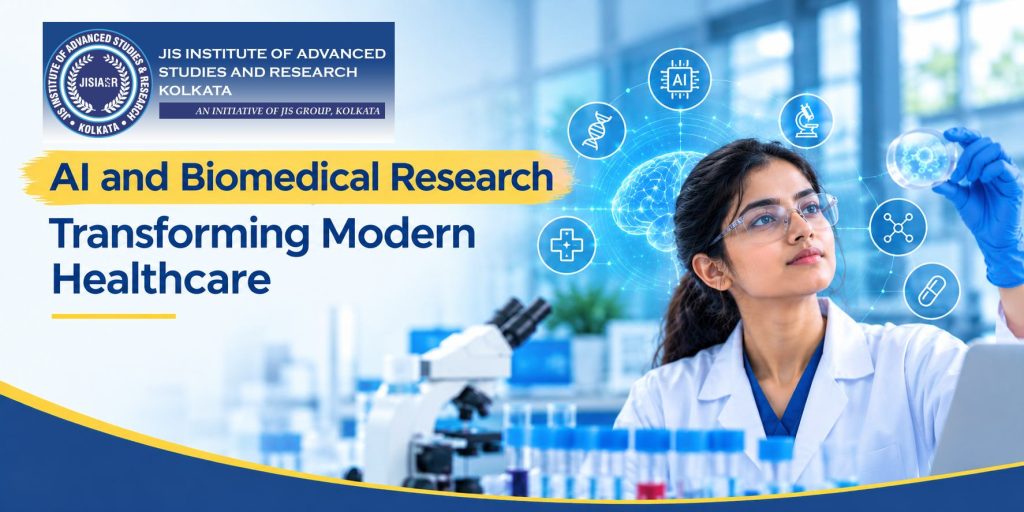
AI and Biomedical Research: Transforming Modern Healthcare

Artificial intelligence is changing how researchers approach some of the most complex challenges in modern healthcare. From analysing medical data and identifying disease patterns to supporting drug discovery and improving diagnostic processes, AI is becoming increasingly connected with biomedical research. An AI biomedical research institute in Kolkata, West Bengal can provide an interdisciplinary environment where computer science, artificial intelligence, biotechnology, healthcare and data science come together. This combination allows researchers and students to explore technology-driven approaches to healthcare problems while developing skills relevant to emerging scientific fields. How AI Is Changing Biomedical Research Traditional biomedical research often involves analysing large amounts of biological, clinical and experimental information. AI and machine learning can help researchers identify patterns in complex datasets and develop computational models for research applications. Some important areas where AI is being explored include: The objective is not to replace medical or scientific expertise but to provide researchers with additional computational methods for analysing information and supporting evidence-based research. The Role of Medical Data in AI Research Healthcare generates large volumes of data through medical imaging, electronic records, laboratory investigations, genomic studies and clinical research. Analysing this information can be challenging because datasets may be large, complex and highly varied. Data science and machine learning techniques can help researchers organise, analyse and interpret such information. For example, machine learning models can be investigated for identifying patterns in medical images or predicting outcomes from specific datasets. Such research requires knowledge of both computational methods and biomedical concepts. This is why interdisciplinary research environments are increasingly important for AI-driven healthcare research. AI and Biomedical Research at JISIASR At the JIS Institute of Advanced Studies and Research (JISIASR), research in data science and related areas provides opportunities to explore the connection between artificial intelligence and healthcare. The institute’s Centre for Data Science identifies research areas including AI and machine learning, medical image processing, AI in healthcare, natural language processing and data analytics. These areas create opportunities for researchers to investigate computational approaches to healthcare and biomedical challenges. AI-related research can involve developing models, analysing datasets, evaluating algorithms and exploring how computational technologies can support scientific research. Medical Image Processing and AI Medical imaging is one of the important areas where artificial intelligence can intersect with biomedical research. Researchers can investigate how machine learning and computer vision techniques can process images from different medical imaging modalities. Potential research applications include image classification, segmentation, feature extraction and automated pattern recognition. However, AI-based medical image research requires careful validation. A model that performs well on one dataset may not necessarily perform equally well on another. Researchers therefore need to consider data quality, model performance, bias, validation and reproducibility. This makes strong research methodology just as important as technical AI skills. Bioinformatics and Computational Biology The combination of biology and computational science has created new opportunities in bioinformatics and computational biology. Researchers can use computational approaches to study biological datasets, including genomic and molecular information. Machine learning can support pattern recognition and predictive modelling in selected research applications. Students interested in this area can benefit from learning: An interdisciplinary background can be particularly useful because biomedical research questions often require both biological understanding and computational expertise. Why Interdisciplinary Research Matters Healthcare problems rarely belong to a single academic discipline. A project involving AI-based disease prediction, for example, may require knowledge of machine learning, statistics, biomedical science and clinical context. Similarly, medical image research can involve computer vision, data science, imaging technology and healthcare expertise. An interdisciplinary research environment can therefore help students understand how different fields contribute to a single research problem. For students considering an AI biomedical research institute in Kolkata, West Bengal, it is useful to examine whether the institution provides opportunities to work across disciplines rather than focusing only on classroom-based AI learning. Skills for Future AI and Biomedical Researchers Students interested in this field should develop both technical and research-oriented skills. Artificial Intelligence A foundation in machine learning, deep learning and data analysis can help students understand how AI models are developed and evaluated. Programming Python is widely used for data analysis and machine learning. Programming skills can help researchers work with datasets and build computational models. Biomedical Knowledge Understanding biological systems, medical terminology and research methods is important when applying AI to healthcare problems. Statistics Statistical knowledge helps researchers interpret datasets, evaluate models and understand uncertainty. Research Methodology Students should learn how to formulate research questions, review scientific literature, design experiments, analyse results and communicate findings. Choosing an AI and Biomedical Research Institute Students and researchers comparing institutes should look beyond the name of the programme. Consider: These factors can help students identify an environment that matches their research interests. The Future of AI in Healthcare Research AI and biomedical research are likely to remain important areas of scientific development as healthcare datasets and computational capabilities continue to grow. Future research may increasingly explore areas such as multimodal AI, personalised healthcare, medical image analysis, computational drug discovery, biomedical language models and intelligent healthcare systems. However, technological progress must be accompanied by responsible research practices. Data privacy, security, transparency, bias, validation and ethical considerations are especially important when AI is applied to healthcare. Conclusion AI is creating new possibilities for biomedical research by providing researchers with advanced methods for analysing complex data and investigating healthcare challenges. An AI biomedical research institute in Kolkata, West Bengal can offer an interdisciplinary environment where artificial intelligence, data science, biomedical science and healthcare research intersect. For students considering this field, the most important step is to examine research areas, faculty expertise, infrastructure and opportunities for practical research. With strong foundations in AI, programming, statistics and biomedical concepts, students can prepare themselves to contribute to the next generation of technology-driven healthcare research. Frequently Asked Questions 1. What is an AI biomedical research institute? An AI biomedical research institute combines artificial intelligence and computational methods with biomedical or healthcare research to investigate problems such as medical imaging, data analysis, disease modelling and bioinformatics. 2. How is AI

Solar and Electric Vehicle Research
Blog, News

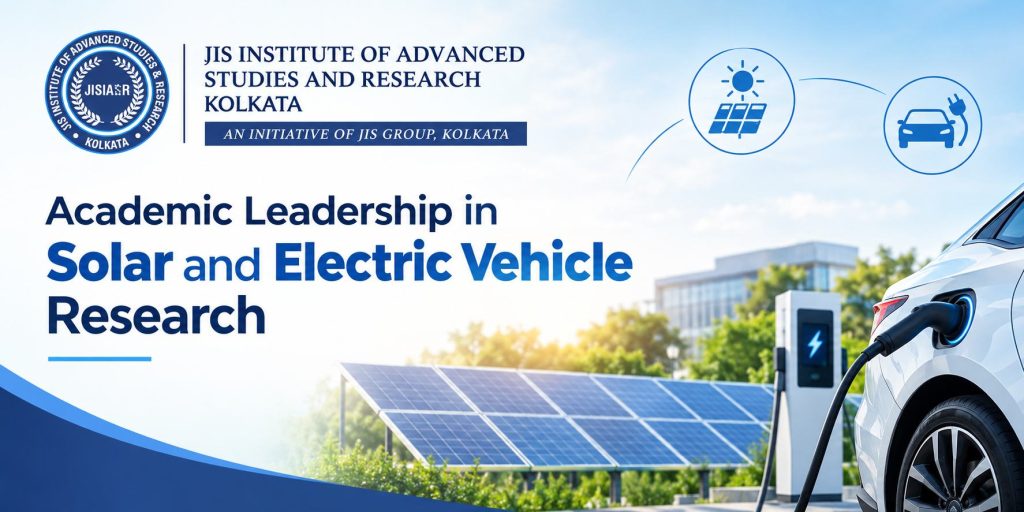
Academic Leadership in Solar and Electric Vehicle Research

The transition towards clean energy and sustainable transportation is creating new opportunities for scientific research and technological innovation. Solar photovoltaic systems, battery storage, electric vehicles and smart energy management are becoming important areas for researchers working towards a more sustainable future. At the JIS Institute of Advanced Studies and Research (JISIASR), the Centre for Renewable & Sustainable Energy Studies (CReSES) focuses on research-driven education in renewable energy and allied technologies. Its research areas include solar photovoltaics, electric vehicle technology, battery systems, smart sensors and sustainable energy solutions. The centre brings together academic expertise and interdisciplinary research to support students and researchers interested in clean energy and green mobility. Research Expertise in Solar Photovoltaic Technology Solar photovoltaic research involves understanding how solar cells and modules generate electricity, how their performance can be improved and how system reliability can be maintained. Research at CReSES includes areas such as: Dr. Sugato Ghosh, associated with the Centre for Renewable & Sustainable Energy Studies, has research interests in solar photovoltaics, PV cleaning and cooling, sensors, MEMS and instrumentation. His academic background includes a Ph.D. in Engineering from IIEST Shibpur. Connecting Solar Energy with Electric Vehicles The development of electric vehicles requires more than electric motors. It also depends on battery technology, charging systems, energy management and the integration of renewable energy sources. Research connecting solar energy and electric vehicles can help explore how photovoltaic systems may support charging and how energy use can be managed more efficiently. Dr. Subinoy Roy’s research interests include photovoltaic reliability assessment, imaging and defect analysis, and load management in PV-powered electric vehicles and hybrid systems. His academic background includes a Ph.D. in Energy Science and Engineering from IIT Bombay. These research areas demonstrate the interdisciplinary connection between materials, energy systems, electronics, data analysis and mobility technologies. Academic Programmes at CReSES JISIASR’s Centre for Renewable & Sustainable Energy Studies offers postgraduate and doctoral programmes related to renewable energy and sustainable technologies. The centre lists the following programmes: The M.Tech. programme covers a two-year duration and is available in regular mode and for working professionals, according to the centre’s official programme information. These programmes are designed to support advanced learning and research in areas connected to clean energy, storage, electric mobility and sustainable systems. Battery Technology and Sustainable Energy Research Battery technology is an important part of the electric vehicle ecosystem. Research in this field may involve energy storage, battery performance, materials, charging systems and battery management. CReSES identifies battery technology, EV systems and smart energy management among its research and academic focus areas. Its broader research scope also includes hydrogen energy, thermal energy systems and smart sensor technologies. Students interested in these areas can explore how engineering and science disciplines work together to solve energy-related challenges. The Importance of Interdisciplinary Research Solar and electric vehicle technologies require knowledge from multiple disciplines. Electrical engineering, electronics, mechanical engineering, materials science, physics, chemistry and data science can all contribute to research and development. An interdisciplinary approach allows researchers to examine energy systems from different perspectives. For example, solar module reliability may involve materials and imaging, while electric vehicle applications may involve batteries, power systems and energy management. CReSES encourages research across renewable energy, instrumentation, electronics, battery technology and sustainable systems through its postgraduate and Ph.D. programmes. Research Skills for Future Energy Scientists Students planning to build careers in renewable energy and electric vehicle research should develop a combination of theoretical and practical skills. Important areas include: Hands-on laboratory work, academic mentorship and research projects can help students understand how scientific concepts are applied to real-world energy challenges. Conclusion Academic research in solar energy and electric vehicles plays an important role in developing sustainable technologies. At JISIASR, the Centre for Renewable & Sustainable Energy Studies brings together research areas such as photovoltaic systems, EV technology, battery systems, smart sensors and renewable energy applications. Through its postgraduate and doctoral programmes, the centre provides opportunities for students and researchers to explore advanced topics in clean energy and green mobility. Students interested in this field should review programme eligibility, research areas, faculty expertise and available facilities before selecting an academic pathway. Frequently Asked Questions 1. What research areas are covered at CReSES, JISIASR? Research areas include solar photovoltaics, renewable energy, electric vehicle technology, battery systems, smart sensors, hydrogen energy and sustainable energy applications. 2. Does JISIASR offer a programme in renewable energy and electric vehicle technology? Yes. CReSES offers an M.Tech. in Renewable Energy and Electric Vehicle Technology, listed as a two-year programme. 3. What qualifications are useful for renewable energy research? Relevant backgrounds may include engineering, physics, chemistry, mathematics, electronics and other related science or engineering disciplines, depending on the programme and research position. 4. Why is solar photovoltaic research important for electric vehicles? Solar photovoltaic research can support investigations into renewable charging, energy generation, system performance and energy management for electric vehicle applications. 5. What skills should students develop for EV research? Students can develop knowledge of battery systems, electrical and electronic systems, energy management, modelling, experimentation and technical documentation. 6. How can students explore research opportunities at JISIASR? Students should visit the official JISIASR website, review the relevant programme information and contact the institute for current eligibility, admission and research opportunity details.

Blog, News

From Machine Learning to Generative AI: The Role of AI Research Centres in Kolkata

Artificial Intelligence (AI) is changing how people work, communicate and solve complex problems. From intelligent software and healthcare applications to cybersecurity and automated systems, AI is becoming an important part of modern research and innovation. As the demand for AI-based solutions grows, students and research aspirants are looking for opportunities to explore technologies beyond basic programming. This is where an AI research centre in Kolkata can provide an environment for advanced learning, experimentation and interdisciplinary research. Kolkata has an established academic ecosystem, with institutions working across computer science, statistics, engineering and scientific research. AI-focused research initiatives in the region demonstrate how artificial intelligence can be applied to different sectors, including healthcare, agriculture, public services and data analytics. For example, the National Informatics Centre’s AI Lab in Kolkata highlights applications such as healthcare AI, agriculture, image analysis and smart traffic systems.  Understanding AI Research AI research involves investigating methods that allow computer systems to perform tasks associated with human intelligence. These tasks may include learning from data, recognising patterns, understanding language, processing images and supporting decision-making. Machine Learning is one of the core areas of AI research. It enables systems to identify patterns in data and improve their performance through training and evaluation. Other important research areas include: A research-focused learning environment allows students to understand not only how to use existing tools but also how algorithms work, where they have limitations and how they can be improved. From Machine Learning to Generative AI Machine Learning and Generative AI are closely connected but serve different purposes. Machine Learning is commonly used for prediction, classification, pattern recognition and data analysis. Generative AI, on the other hand, focuses on producing content such as text, images, audio, code and other outputs based on learned patterns. Generative AI has created new research questions involving accuracy, bias, privacy, explainability and responsible use. Students interested in this field need a foundation in mathematics, programming, statistics, data handling and model evaluation. An AI research centre in Kolkata can support this learning through academic projects, research guidance, technical workshops and practical experimentation. Importance of Interdisciplinary AI Research AI is not limited to the computer science field. Its applications extend across healthcare, finance, education, environmental research, agriculture and industrial technology. For example, AI can support medical image analysis, detect patterns in scientific data, improve business forecasting and assist with cybersecurity monitoring. However, successful implementation requires knowledge of both AI methods and the specific domain in which they are applied. Interdisciplinary research encourages students to work across different subjects and understand how technology can address practical challenges. Research Opportunities at JISIASR The JIS Institute of Advanced Studies and Research (JISIASR), Kolkata, offers a Centre for Data Science that includes research and postgraduate learning in areas related to Artificial Intelligence and Machine Learning. Its published research areas include AI and Machine Learning, Natural Language Processing, medical image processing, business analytics, cybersecurity, blockchain, IoT and satellite image processing. The centre also describes industry-oriented projects and interdisciplinary research as part of its academic approach.  These areas can be relevant for students seeking to develop research skills or explore advanced study in AI and Data Science. Skills Required for AI Research Careers Students planning a career in AI research should build a strong technical foundation. Programming languages such as Python, along with statistics, linear algebra, algorithms and data structures, can support further learning. Practical experience is equally important. Students can work on datasets, develop machine learning models, evaluate results and document their findings through projects. Communication skills also matter because research often involves presenting ideas, writing reports, collaborating with other researchers and explaining technical results to different audiences. Career Scope in Artificial Intelligence AI research and development can lead to opportunities in several technical areas. Depending on their educational qualifications and specialisation, graduates may explore roles such as: Some advanced research positions may require postgraduate qualifications or a PhD. Students should therefore consider whether their chosen institution provides opportunities for higher studies, research projects and academic mentorship. How to Choose an AI Research Centre in Kolkata Before selecting an AI research centre in Kolkata, students should review the research areas, faculty expertise, available laboratories and academic programmes. It is useful to ask whether the institution supports hands-on projects, interdisciplinary collaboration, industry exposure and opportunities to present research. Students should also check the eligibility criteria and curriculum of the relevant postgraduate or doctoral programme. A suitable research environment should help students develop independent thinking, technical knowledge and the ability to investigate complex problems. Final Thoughts Artificial Intelligence is developing rapidly, from traditional Machine Learning to Generative AI and domain-specific applications. This creates opportunities for students who want to explore research, innovation and advanced technology careers. Choosing an AI research centre in Kolkata should involve more than looking at the popularity of a course. Students should consider research facilities, mentorship, practical exposure, specialisations and long-term academic goals. With consistent learning and meaningful project experience, students can build the foundation needed to participate in the next generation of AI research and technological innovation. Frequently Asked Questions 1. What is an AI research centre? An AI research centre is an academic or scientific environment focused on studying and developing artificial intelligence technologies, including machine learning, computer vision and natural language processing. 2. What research areas are available in AI? Common areas include machine learning, deep learning, Generative AI, NLP, computer vision, cybersecurity, predictive analytics and AI applications in healthcare. 3. What should I look for in an AI research centre in Kolkata? Consider faculty expertise, research areas, laboratories, academic programmes, practical projects, industry collaboration and opportunities for higher studies. 4. Is programming necessary for AI research? Yes. Programming, particularly Python, is widely used in AI research. Knowledge of mathematics, statistics and algorithms is also valuable. 5. Can AI research lead to a PhD? Yes. Students who meet institutional eligibility requirements can pursue doctoral research in AI-related areas such as machine learning, NLP, computer vision and data analytics. 6. What careers are available after studying AI? Depending on their

Blog, News

Why Choose a Data Science Research Centre in Kolkata, West Bengal for Advanced Research and Innovation?

Data is becoming one of the most valuable resources for organisations, researchers and industries across the world. From healthcare and finance to transportation, cybersecurity, business and scientific research, the ability to collect, process and interpret large volumes of data is changing how complex problems are solved. As this transformation continues, students and research aspirants are looking beyond conventional classroom education. They are looking for institutions where they can explore real-world problems, work with advanced technologies, collaborate with researchers and develop solutions with practical applications. This is where choosing the right Data Science Research Centre in Kolkata can make a meaningful difference. Kolkata has a strong academic and research ecosystem, with institutions working across statistics, computer science, artificial intelligence, machine learning and other data-driven disciplines. For example, the Indian Statistical Institute’s IDEAS Technology Innovation Hub focuses on Data Science, Big Data Analytics and Data Curation, while other Kolkata institutions have developed dedicated programmes and research activities in Data Science. For students planning advanced studies or research in Data Science, Kolkata therefore offers an environment where academic knowledge can connect with research, technology and innovation. What Is a Data Science Research Centre? A Data Science Research Centre is more than a place where students learn programming or data analytics. It is an academic and research environment where statistical methods, mathematics, computer science, artificial intelligence and machine learning can be brought together to investigate complex problems. A research-oriented centre may involve activities such as: The objective is generally to move beyond theoretical understanding and investigate how data-driven methods can address practical challenges. For example, research in Data Science can contribute to areas such as disease prediction, financial risk analysis, intelligent transportation, fraud detection, climate modelling, image processing and smart-city applications. Why Choose a Data Science Research Centre in Kolkata? 1. Access to a Strong Academic and Research Ecosystem One of the biggest advantages of pursuing research in Kolkata is the city’s established academic environment. Kolkata and the surrounding region are home to universities, specialised research institutes and technology-focused centres. This creates opportunities for students to engage with different academic disciplines and research perspectives. The ecosystem includes institutions working in statistics, computational science, engineering, healthcare, natural sciences and technology. Such an environment can be particularly valuable for Data Science because modern data-driven research rarely remains limited to one discipline. A Data Science researcher may work with healthcare researchers one day, engineers the next and business or environmental researchers on another project. 2. Interdisciplinary Research Opportunities Modern Data Science is inherently interdisciplinary. A machine learning model, for instance, may require statistical knowledge, programming expertise and domain-specific understanding. A healthcare project may combine Data Science with medical science, while satellite-image analysis may involve computer vision, geography and environmental science. This is one reason research-focused institutes with multiple academic centres can provide an advantage. JIS Institute of Advanced Studies and Research (JISIASR), Kolkata, for example, operates centres covering Data Science, Health Science and Technology, Interdisciplinary Sciences, and Renewable & Sustainable Energy Studies. The institute describes its approach as translational and industry-oriented, with collaboration across centres. Such an interdisciplinary environment can help researchers look at problems from multiple perspectives rather than treating Data Science as an isolated technical subject. 3. Research in Artificial Intelligence and Machine Learning Artificial Intelligence and Machine Learning are among the most important areas within modern Data Science. Research centres allow students to go beyond simply using existing machine learning libraries. Research-oriented learning can involve understanding algorithms, evaluating models, analysing datasets and developing approaches for specific problems. Areas may include: At JISIASR’s Centre for Data Science, current PhD areas include AI and machine learning, medical image processing, business analytics, cybersecurity, natural language processing, blockchain, IoT and satellite image processing. This breadth demonstrates how Data Science research can extend across technology and application domains. 4. Opportunities for Real-World Research One of the most important differences between conventional education and research-oriented education is exposure to real problems. A research project begins with a question or challenge. The researcher then needs to identify suitable data, understand the problem, select methodologies, conduct experiments and interpret the results. This process develops skills that cannot always be gained through classroom assignments alone. For example, a student could work on: Healthcare: Predicting disease patterns using patient or medical datasets. Finance: Developing models for risk analysis or fraud detection. Transportation: Using data to understand traffic patterns and improve mobility. Business: Analysing customer behaviour to support better decision-making. Environment: Using large datasets to study environmental or climate-related trends. This type of research can help students understand how Data Science is actually applied outside textbooks. 5. Advanced Laboratory and Computational Exposure Data Science research requires appropriate technological infrastructure. Depending on the project, researchers may need access to computing systems, statistical software, programming environments, databases, machine learning frameworks and other specialised tools. A strong research centre should therefore provide more than classrooms. It should create an environment where students can experiment, test models and work on research projects. JISIASR highlights state-of-the-art laboratories, hands-on research exposure and expertise in Data Science and AI among its academic strengths. Its published programme information also describes exposure to areas including probability and statistics, advanced databases, mathematical modelling, visualisation, machine learning, AI, Big Data and data security. 6. Experienced Faculty and Research Mentorship Good research depends heavily on mentorship. Students entering advanced research may have a broad interest in Data Science but need guidance to convert that interest into a focused research question. Faculty members can help with research methodology, literature reviews, experimentation, paper writing and project development. A research centre with faculty from different technical backgrounds can also provide broader exposure. For example, faculty associated with JISIASR’s Centre for Data Science have backgrounds spanning computer science, engineering and research institutions, demonstrating the importance of specialised academic expertise within a research environment. The right mentor can therefore influence not only a student’s academic progress but also the direction of their future research career. 7. Industry-Oriented Research and Innovation Data Science has strong connections with industry because organisations increasingly depend

Advanced Scientific Research Institute in Kolkata
Blog, News, Uncategorized

Why Choose an Advanced Scientific Research Institute in Kolkata for Higher Studies and Research?

Science is constantly evolving. From artificial intelligence and biotechnology to renewable energy, healthcare, environmental science, and advanced materials, scientific research is influencing almost every part of modern life. For students who want to build a career in science and research, choosing the right academic environment is therefore more important than simply selecting a degree programme. An Advanced Scientific Research Institute in Kolkata can provide students with an environment where academic knowledge, practical learning, research, and innovation come together. Instead of focusing only on textbooks and examinations, research-oriented education encourages students to ask questions, analyse problems, conduct experiments, and explore solutions. Kolkata has a strong academic culture and is home to a wide range of educational and research institutions. For students looking to pursue higher studies and develop research skills, the city offers an environment that can support both academic and professional growth. What Is an Advanced Scientific Research Institute? An advanced scientific research institute is an educational and research-focused institution that provides opportunities to explore scientific subjects in greater depth. Such institutes generally place greater emphasis on research methodology, laboratory work, experimentation, innovation, and interdisciplinary learning. The objective is not simply to help students complete a course. It is to develop the ability to understand complex scientific problems and approach them systematically. At an Advanced Scientific Research Institute in Kolkata, students may get opportunities to participate in research projects, laboratory activities, seminars, workshops, academic discussions, and other practical learning experiences. This approach can be particularly useful for students planning to pursue postgraduate education, doctoral research, academic careers, or research-oriented roles in industry. Why Choose Kolkata for Higher Studies and Research? Kolkata has a long-established reputation as an educational and intellectual centre. Students from West Bengal and other parts of India come to the city to pursue undergraduate, postgraduate, professional, and research-oriented programmes. The city’s academic ecosystem can provide students with opportunities to interact with educators, researchers, professionals, and students from different backgrounds. Another advantage is the availability of academic resources. Depending on the institution and programme, students may have access to specialised laboratories, libraries, digital research resources, seminars, workshops, conferences, and collaborative academic activities. For students interested in scientific research, studying in Kolkata can therefore provide exposure to a broader academic environment while allowing them to build their own professional network. 1. Research-Oriented Learning One of the major benefits of joining a research-focused institution is the opportunity to learn through investigation and experimentation. Traditional classroom learning provides students with important theoretical foundations. However, research-based learning encourages them to take the next step by asking: This style of learning can improve critical thinking and help students become more independent learners. 2. Modern Laboratory and Research Facilities Practical experience is an important part of scientific education. A well-equipped laboratory allows students to apply theoretical concepts and understand scientific processes through experimentation. When selecting an Advanced Scientific Research Institute in Kolkata, students should carefully examine the available infrastructure. Important facilities may include: Access to appropriate facilities can help students gain confidence in laboratory procedures and research techniques. 3. Experienced Faculty and Research Mentors Good research requires proper guidance. Experienced faculty members can help students understand complex concepts, identify research questions, select appropriate methodologies, and interpret results. Faculty members with active research interests can also expose students to current developments in their respective fields. Students considering an Advanced Scientific Research Institute in Kolkata should therefore look at the faculty profile of the institute. Their academic qualifications, areas of expertise, research interests, publications, and projects can provide useful information about the academic environment. Strong mentorship can make the research experience more structured and productive. 4. Interdisciplinary Research Opportunities Modern scientific problems are increasingly interconnected. Healthcare, climate change, artificial intelligence, biotechnology, renewable energy, materials science, and environmental challenges often require knowledge from more than one discipline. Interdisciplinary learning allows students to understand these connections. For example, biotechnology can be combined with data science, environmental studies can work alongside engineering, and artificial intelligence can support research in healthcare and life sciences. An Advanced Scientific Research Institute in Kolkata that encourages interdisciplinary learning can help students develop a broader understanding of science and its applications. 5. Practical Exposure and Project-Based Learning Research becomes more meaningful when students get opportunities to apply their knowledge. Project-based learning can involve laboratory experiments, field studies, data collection, scientific analysis, technical presentations, and research reports. Students can learn how to approach a problem from beginning to end—from identifying a question and collecting information to analysing findings and presenting conclusions. Seminars, workshops, conferences, internships, and academic events can further strengthen this experience. Such exposure can also help students understand the expectations of research laboratories and scientific organisations. 6. Development of Research Skills A successful researcher needs more than strong subject knowledge. Research requires several practical and analytical skills that students can develop during higher studies. These include: These skills can benefit students whether they eventually choose academic research, industry, technology, healthcare, laboratory work, or other scientific careers. 7. Encouragement for Innovation Research and innovation are closely connected. Scientific research can identify new problems, improve existing methods, and create opportunities for developing new technologies or applications. A research-oriented institute can encourage students to think beyond established solutions. Students may work on ideas related to healthcare, sustainability, energy, environmental protection, technology, agriculture, biotechnology, or other emerging areas. This exposure can help students understand how scientific knowledge can move from an academic concept towards a practical application. 8. Preparation for Higher Research Degrees Students who intend to pursue postgraduate research or doctoral programmes can benefit from gaining research exposure early in their academic journey. Research projects introduce students to important aspects of academic research, including literature review, experimental design, data interpretation, scientific writing, and research presentation. This experience can help students understand whether research is the right career path for them and prepare them for more advanced academic programmes. 9. Career Opportunities After Research-Based Education Research-oriented education can lead to a variety of career opportunities depending on a student’s qualification and specialisation. Potential career areas include:

Blog, News, Uncategorized

Career Opportunities After M.Tech Computer Science with Data Science in Kolkata: Jobs & Salary Guide 2026

Introduction: Every time Netflix recommends a movie, Google Maps shows the fastest route, or a bank detects fraud — Data Science is working silently in the background. Here’s a surprising fact:   According to industry reports, Data Science roles are among the top 5 highest-demand tech jobs in India, and the demand is growing faster in metro and tier-1 cities like Kolkata. That’s why many students and parents are now asking:👉 “What career opportunities are available after M.Tech Computer Science with Data Science in Kolkata?” 👉 “What salary can we realistically expect in 2026?” This guide answers everything — clearly, honestly, and simply. What is M.Tech Computer Science with Data Science? M.Tech Computer Science with Data Science is a postgraduate engineering degree that combines: It prepares students to analyze data, build intelligent systems, and solve real-world problems using technology. If you are searching for the best data science course in Kolkata, this specialization is one of the strongest academic options. Why Choose This Course in Kolkata? Kolkata is fast emerging as a technology and analytics hub due to: For students in East India, M.Tech Computer Science with Data Science in Kolkata offers high value at reasonable cost. Career Opportunities After M.Tech in Data Science Top Job Roles You Can Get After completing this degree, you can work as: These roles exist across IT companies, startups, banks, hospitals, e-commerce firms, and research labs. Data Scientist Salary in Kolkata (2026 Estimate) Experience Level Expected Salary Fresher ₹5 – 8 LPA 2–4 Years ₹9 – 15 LPA 5–7 Years ₹18 – 25 LPA Senior / Lead ₹30 LPA+ 📌 Salaries depend on skills, projects, internships, and problem-solving ability, not just degree. Real-Life Example (Simple Case Study) Amit, an M.Tech graduate from Kolkata, specialized in Data Science.During his course, he: After graduation, he joined a fintech company as a Data Analyst with ₹7 LPA, and within 3 years moved into a Data Scientist role. 👉 Skill + degree = success. Industries Hiring Data Science Professionals You can work in: This wide scope makes Data Science a future-proof career choice. Pros & Cons of M.Tech in Data Science Pros ✅ Cons ⚠️ High demand & salary Requires strong logic Global job opportunities Continuous learning needed Multiple career paths Competitive job market Work on real-world problems Math & coding involved Strong future growth Not ideal if you dislike data Future Trends in Data Science (2026 & Beyond) According to global tech forecasts: 📈 This means long-term career stability for data science professionals. Step-by-Step Guide: How to Build a Career After M.Tech Step 1: Master the Basics Focus on: Step 2: Learn Tools Step 3: Build Projects Step 4: Do Internships Hands-on experience matters more than marks. Step 5: Apply Smartly Top Skills Required for Data Science Careers You should develop: 👉 These skills help you stand out in the job market. Tips for Students & Parents FAQs – Answering Common Questions 1️⃣ Is M.Tech in Data Science difficult? It is challenging but manageable with practice. 2️⃣ Can non-CS students apply? Some colleges allow related branches like IT or Electronics. 3️⃣ Is Kolkata good for data science jobs? Yes, demand is growing rapidly. 4️⃣ Do I need coding knowledge before admission? Not mandatory, but helpful. 5️⃣ Is salary lower in Kolkata than Bangalore? Initially slightly lower, but cost of living is much lower too. 6️⃣ Can I go abroad after this degree? Yes, many students pursue PhD or global jobs. Conclusion: Is It Worth It in 2026? If you are interested in technology, data, and problem-solving, then M.Tech Computer Science with Data Science in Kolkata is absolutely worth it in 2026. It offers:✅ Strong career growth✅ High salary potential✅ Job security✅ Global opportunities Click Now: View More JISIASR

Blog, News, Uncategorized

MSc in Computer Science in Kolkata: Complete Admission Guide with Eligibility, Fees & Placements

You open your phone, book a cab, order food, stream a movie, and pay online — all in 10 minutes. Behind every app, website, and digital service is Computer Science. Today, India is one of the world’s fastest-growing tech nations. According to NASSCOM, India employs over 5 million IT professionals, and demand keeps rising every year. This is why more students are now choosing MSc in Computer Science in Kolkata as a smart career move. If you are confused about Computer Science admission in Kolkata, West Bengal, this guide will give you complete clarity — eligibility, fees, placements, career scope, and how to get started. What is MSc in Computer Science? MSc in Computer Science is a 2-year postgraduate degree that focuses on: It is ideal for students who love problem-solving, logic, and technology. Why Choose MSc in Computer Science in Kolkata? Kolkata is emerging as a strong education and IT hub due to: If you want quality education at reasonable cost, Kolkata is a great choice. MSc Computer Science Eligibility and Fees in Kolkata Eligibility Criteria You generally need: Approximate Fees College Type Total Fees (2 Years) Government College ₹40,000 – ₹1,20,000 Private College ₹1,50,000 – ₹4,00,000 📌 Tip: Always check scholarship options, especially for meritorious students and economically weaker sections. Admission Process – Step-by-Step Guide Step 1: Shortlist Colleges Look for colleges that offer: Step 2: Check Admission Mode Step 3: Apply Online/Offline Fill application form, upload documents, and pay fees. Step 4: Counseling/Interview (if applicable) Step 5: Confirm Admission Placements After MSc in Computer Science in Kolkata Top Job Roles You can work as: Expected Salary Experience Level Salary Range Fresher ₹3–7 LPA 3–5 Years ₹8–15 LPA 7+ Years ₹18–30 LPA+ Companies like TCS, Wipro, Infosys, Cognizant, and startups regularly hire from Kolkata colleges. Future Trends in Computer Science By 2030, experts predict major growth in: This makes MSc in Computer Science a future-proof degree. Pros & Cons of MSc in Computer Science Pros ✅ Cons ⚠️ High demand jobs Needs consistent practice Good salary Competitive market Work anywhere in the world Requires strong logic Many career paths Needs continuous upskilling Strong future scope Not ideal if you dislike coding Top Skills You Should Develop To succeed, focus on: How to Get Started (Beginner Plan) Real-Life Example (Simple Case Study) Riya from Kolkata completed MSc in Computer Science. She did internships in Data Analytics and built 3 projects.After graduation, she joined an IT company with ₹6 LPA salary — all because she focused on skills, not just marks. Best Colleges in Kolkata for MSc Computer Science (Examples) (Check official websites for latest updates) FAQs (Simple Language) 1️⃣ Is MSc in Computer Science difficult? It is challenging but manageable with practice. 2️⃣ Can BCA students apply? Yes, most colleges accept BCA graduates. 3️⃣ Is Kolkata good for IT jobs? Yes — especially in Sector V and New Town. 4️⃣ Can I go abroad after MSc? Yes, for higher studies or jobs. 5️⃣ Do I need coding before admission? Not mandatory, but helpful. 6️⃣ Are scholarships available? Yes, in many colleges. 7️⃣ Is placement guaranteed? No degree guarantees placement, but strong skills increase chances. Conclusion  If you want a stable, high-paying, and future-ready career, MSc in Computer Science in Kolkata is an excellent choice. 👉 Next Step for You: If you want, I can help you:

Blog, News, Uncategorized

Is MTech in Renewable Energy & Electric Vehicle Technology Worth It in 2026?

You wake up, your house runs on solar power, your school bus is electric, and the city air is cleaner because most vehicles are EVs. This is not the future anymore  this is happening now. India is rapidly shifting toward green energy and electric mobility, and professionals who understand renewable energy and EV technology are becoming extremely valuable. That’s why students and parents are now asking: 👉 “Is MTech in Renewable Energy in Kolkata really worth it in 2026?” Let’s break it down clearly, simply, and honestly. What is MTech in Renewable Energy & EV Technology? This is a specialised master’s degree that combines: If you love science + technology + environment + innovation, this is a strong match. Why Is This Field Growing Fast? (Latest Trends & Reality Check) 🔹 India’s Green Push 🔹 EV Market Boom 📌 What this means for students:More projects, more jobs, and better salaries. Is MTech in Renewable Energy in Kolkata a Good Choice? Why Kolkata is a Good Location Kolkata is becoming a strong education hub for sustainability and engineering: So yes  Best renewable energy course in Kolkata is now a serious academic pathway. Pros & Cons of MTech in Renewable Energy & EV Technology Pros ✅ Cons ⚠️ High demand in future Requires strong math & physics Good salaries Still emerging in some cities Meaningful work for climate Needs continuous learning Global opportunities Not all colleges have strong labs Government support Competitive job market Career Scope After MTech in Renewable Energy & EV Tech You can work as: Top Hiring Sectors Renewable Energy Engineer Salary in India (2026 Estimate) Experience Expected Salary Fresher ₹4–8 LPA 3–5 years ₹8–14 LPA 7–10 years ₹15–25 LPA+ 👉 In cities like Bangalore, Pune, Hyderabad, and Kolkata, salaries are rising due to green projects. Real-Life Example (Case Study) Case: Solar Microgrid in Rural Bengal A team of MTech renewable graduates worked on: Result: 👉 This is exactly the kind of impact you can make with this degree. Step-by-Step Guide: Should You Choose This Course? Step 1 — Check your interest Ask yourself: If yes → proceed. Step 2 — Choose the right college Look for: Step 3 — Build skills early Start learning: Step 4 — Do internships Try: Step 5 — Work on projects Build: Top Skills Required You should aim to develop: Future Trends in Renewable & EV Tech Here’s what experts expect by 2030: This means job security + innovation + global opportunities. Is This the Best Renewable Energy Course in Kolkata? If your college offers: Then yes MTech in Renewable Energy in Kolkata is absolutely worth it. FAQs 1️⃣ Is this course very difficult?It is challenging but manageable with regular practice. 2️⃣ Can non-electrical students apply?Yes — mechanical, electronics, and related branches can apply. 3️⃣ Are government jobs available?Yes — in MNRE, power boards, and PSUs. 4️⃣ Is it better than software?It depends on your interest. If you love green tech, this may be better for you. 5️⃣ Will EV jobs grow?Yes, strongly in the next 10 years. 6️⃣ Can I go abroad after this?Yes — many students pursue research or jobs in Europe, USA, and Germany. 7️⃣ Is Kolkata a good city for this?Yes, especially with increasing solar and smart grid projects in Eastern India. Final Verdict — Is It Worth It in 2026? ✅ YES — if you are passionate about clean energy, technology, and innovation.❌ NO — if you only want an easy high-paying job without effort. This field rewards curiosity, patience, and problem-solving. Conclusion  If you are serious about building a future-proof career in energy and mobility, MTech in Renewable Energy in Kolkata is a smart, meaningful, and high-growth choice. 👉 Next Step for You: If you want, I can help you shortlist colleges, compare courses, or prepare for admissions  just ask!

Scroll to Top